Showing posts with label Disabilities. Show all posts

Monday, January 16, 2017

Bildungsroman: A College Entrance Essay

Adulthood is not achieved in a single step.  It is a process of years, the first seeds 
planted in the milestones of childhood—in the four-year-old’s first self-cooked hotdog, 
the six-year-old’s first attempt at babysitting, the ten-year-old’s acceptance of a 
constantly changing world beyond their control.  Often we try to pinpoint the exact 
moment of maturation, attempting to capture the concept in something as simple as a 
jumped train or special birthday, but the reality of the situation is that childhood is not a 
garment, not a cloak to be ripped off all at once to reveal the adulthood 
beneath—childhood is a skin we shed scale-by-scale throughout the years, the inches 
slipping away until one day we peer back and realize that new flesh is all we now 
possess.  That singularity we seek is not really a moment of becoming—it’s a cosmic 
instant in which some portion of the world recognizes the denouement of the childhood 
journey and the quickening of a new age of life.   

 In the eyes of my community, the culmination of my maturation came shortly 
after my diagnosis of Tourette’s Syndrome.  In September of 2010, I was diagnosed with 
a late-onset and increasingly active case of Tourette’s, which included violent physical 
tics and loud verbal tics, such as coprolalia. 

As the news spread and my classmates became accustomed to my outbursts, it 
became clear that word-of-mouth was not enoughupperclassmen could be brutal, 
lowerclassmen could be petty, and teachers, ignorant of my disorder, badgered me to 
tears.  Education, I posited, was the key; in the dark, we are afraid because we cannot see, 
and if ignorance is dismantled, enlightenment casts out the fear that leads us to ostracize 
others.  Thus, in a meeting with the principal, I proposed that I give a series of 
presentations on Tourette’s to the school.  
Within a monthI had given presentations to the student body, the faculty, and the 
school board.  The teasing vanished almost completely. 
I was asked by a local human service agency to present to their groups in nine 
counties and to speak at the Families Together Conference in Albany, but my greatest 
achievement occurred in the library at the Newark Valley Elementary School, where I 
advocated for a second-grader with Tourette’s, fighting to receive the necessary services 
from the school. 
I spoke to the entire faculty, fluidly and with authority; I easily answered every 
question.  My presentation was interactive and the audience was required to simulate two 
tics while writing the Pledge of Allegiance in ninety seconds or less; they would erase 
every third word written and rewrite it, and tap their pinky to the corner of the desk each 
time I clapped my hands.  As expected, no one was able to complete the task.  
It was in that moment that I reached, in my own heart, the climax of my childhood 
journey.  I, still a student, aged fourteen, had become a teacher of teachers, the educator 
of administrators, and the key to a young boy’s education.  I could see the gears turning 
in the minds of the faculty, the lights going on behind their eyes.  It was a wave of 
understanding, and the response to my lecture was almost immediate—in the space of 
perhaps an hour, administrators who had completely refused the idea of a 504 were eager 
to sit down and properly hash out a plan to put the boy on track. 
The transition to adulthood is little more and nothing less than a slow process of 
taking on responsibilities, one-by-one, until the world acknowledges your capacity to 
contribute.  An adult is defined by their ability to do for others as well as for themselves, 
so it wasn’t until I took to advocating for others that the scales I had been shedding came 
loose, the shredded leather torn away in the strong winter winds to reveal the woman 
beneath. 

Monday, August 8, 2016

Children Will Listen

Today's blog post comes with theme music!  


     On Friday, my mother got home from work as my brother and I were about to take a walk to the Dandy, so we invited her along.  We had a nice walk as a family, and when we got back my brother asked if we could go down to the mall so he could buy some hats he'd planned on picking up before some of his friends canceled on him.

     We were having a good time, so we hopped in the car and drove the 45 minutes or so down to the mall, where we almost never go.  As long as we were out, we decided to have dinner, so when John had picked out his Suicide Squad and Dipper Pines hats, we headed up to Friendly's on the second level, to feast on ice cream and get actual food to take home.

     As I have discussed before, I have Tourette's Syndrome, which is a neurological condition in which a dopaminurgic disregulation results in vocal and mechanical tics.  Essentially, I make weird involuntary noises and twitch a lot.  Sometimes I swear, sometimes I scream, sometimes I trill like a bird, and I never know what's coming next or when a new tic will present itself.

     As mentioned in previous posts, one of the things that sets off my tics is changes in temperature, and in NY state we've had a long string of very, very hot weeks, so everyone keeps their air conditioning cranked up to eleven, which means a pretty severe change in temp whenever I enter a public building.  I'm also cold blooded (actual Reptilian Maggie Coates for Overlord 2k16), so the cold gets to me fairly quickly.

     This is all to say that by the end of our dining experience, during which I consumed an ice cream sundae for bonus cold points, I was feeling pretty ticky.

      I wasn't really paying much attention to anyone else in the restaurant until I turned my head to shout "Goddamn" at the cushion of my seat, at which point I heard the mother of two at the table behind me say, "Well she's going to Hell."

     At this point I'd like to remind you that this is not a nice thing to say about anyone, regardless of your personal religious views, especially when you are well within earshot of the person to whom you are referring.

      The children laughed, because of course they would, Mommy made a funny, and when Mommy makes a funny, we laugh.  The little boy then proceeded to make coo-coo bird noises at me as I twitched and jerked about, and if I had looked behind me I probably would have caught him with a finger looping aerial circles around his ear.  His mother laughed and let him continue with this for about a minute before she told him he should probably be quieter.

     No shit, Mom.

     At no point did I turn to speak to her, though I wanted to.  After strike two I decided if they said anything further, I'd say something, but we left shortly thereafter.

     As soon as we left, I wished I had said something.  I always feel that way after I decide to "just ignore it."  It makes me feel as though I've betrayed my people--as though I've let down the entire human race, even. Certainly I've deprived those children of an early opportunity to learn from their mother's mistakes.

     "But Maggie, you're overreacting!  She couldn't have known you had Tourette's!"  Okay, yeah, maybe not.  But should that have mattered?  For one, when I do my herky-jerky tics, which I was doing then, I look a lot like I'm having a seizure or a stroke.  If you were having a seizure or a stroke, and you heard people making fun of you instead of maybe, I don't know, wondering if you were okay or maybe needed medical assistance, you wouldn't be super pleased, now would you?

     "But you weren't having a stroke or a seizure!"  Okay, true.  But it's still demeaning and dehumanizing, other-izing at the very least.  It's embarrassing enough to have people stare at you whenever you go out in public, to have to calm down the wait staff whenever you scream for no reason, or worry that that police officer is going to think you're flashing gang signs or flipping them off on purpose or is going to arrest you for public indecency (you can still, I'll remind you, be arrested or fined for public cursing in this country).  Having people openly mocking you, children, openly mocking you, is demoralizing at its best.

     And what if my actions weren't the result of a neurological disorder?  If I really was suffering from a nervous breakdown (which I have done before and will do again, or my surname isn't Coates), or delusions, or I had the DT's or some other form of withdrawal?  If I was having a psychotic episode, would that make me any less deserving of basic human empathy?  Would that make it any more right to mock me for something I couldn't control?

      There's no honor in mocking the disabled.

      Let me say it louder for the people in the back:  There is no honor in mocking the disabled.

     There's certainly no honor in (essentially) telling someone they're going to hell because they swore involuntarily.  I've been through that before, lady, my classmates in high school called me Satan for years, and every other week someone openly wonders if I'm possessed.  Brushing it off is second nature at this point.  Brushing a lot of things off is second nature at this point.

     And yet....

     I can't really let this one go until I get it off my chest, this you-didn't-say-anything guilt that I get.  Because it's me today, and I can take it--next week is someone just slightly less stable than I am, someone more vulnerable, someone younger, someone more afraid, someone less able to defend themselves, someone who hates themselves more, someone--anyone!  Because cruelty, especially cruelty to a stranger, doesn't stop with one person.  Cruelty to a stranger never stops with one person.

     And probably what bugs me most about this particular case was that this was a mother, teaching her two young children through example and tacit approval that it's perfectly acceptable to make fun of disabled people within their range of hearing.  Teaching her children, through example and tacit approval, that people with disabilities, people who behave a little oddly, people who dare to act a little different than the norm, do not deserve respect and exist to be ridiculed.

     And that--that right there--is what kills me.  That's what makes me so angry, so frustrated with myself for not speaking up.  It's one thing for a judgmental asshole to be wandering the world, making fun of young women (teenagers) for things they can't control.  But to teach your children that that is an acceptable lifestyle is unconscionable!  If it had been a child poking fun, and the parent had reprimanded them, I'd let it go--I'd know that the kid was in competent hands, and the parents were doing their best to do right by their kid.

     But it's not fair to me, or others like me, when a parent teaches their children to mock.  It's not fair to the children, that they're being taught by their parents to mock.  It's not fair to those children's children, either--and somewhere along that family line, there's going to be a child who ends up "off."  Tourette's has a typical onset of ages 7-12, so in the next six years, both those kids could wake up one day with tics!  They probably won't, and I wouldn't wish it on them (life is hard enough already, and with that kind of mother they don't need this kind of hot mess on their plates), but everyone who thinks they're normal eventually finds out they're wrong.  Unless they're deluding themselves.

     Here's the facts:  Children listen to what you say, watch what you do, and learn from what you teach, whether you intend them to or not.  If you're cruel to other people, your children will become cruel; if you're kind to other people, your children will become kind.

     But children also pay attention to what you don't say, to what you don't do, to what your face does when they do something.  They seek your approval and try to please you.  And if your son finds out that making fun of "crazies" makes you laugh, he'll do it again.  And again.  And again and again and again.  Because it makes Mommy happy, so it's the right thing to do.   Children follow in the footsteps of their parents and teachers, and a lot of the time, bullying begins with the adults.  With that we-are-both-sane-so-we-are-inherently-better laugh, or a smile that says "God that kid was so annoying, I have to reprimand you for hitting her but Jesus Christ did I want to do it myself, good job."

     Children want to make their parents happy.

      So be the person your Mom would want you to be.  Or, if your mother was an ass, be better than she was.  Encourage your children to be better than you are--why would we have children if we didn't want a better world for them than the world we grew up in ourselves?

     And if you're going to make fun of disabled people, don't do it in front of your kids.  They'll listen.

     Then they'll repeat.

Friday, July 15, 2016

On Repo! The Genetic Opera: Why "Genetic Emancipation" Falls Flat; a Critique of the Cure Narrative

SPOILERS FOR REPO! THE GENETIC OPERA AHEAD


     Let me be blunt:

     Repo! The Genetic Opera is my shit.

     I waited three years to see it after watching "Let The Monster Rise" on Youtube, and I'm honestly considering the DVD now that's off Netflix (a true travesty).  The musical score is amazing, every song furthers the narrative, the actors' voices are transcendent (give me Anthony Stewart Head in everything please, I need his voice in every soundtrack from here until the end of time), the scenery is perfectly eerie, the way the story is told is fascinating and engaging, the characters are delightfully complex and twisted, and I just can't praise this movie enough.  Someone hire me to talk this movie up to people, I'll do it and I'll do it with soul.

[warning again, spoilers from hereon in]

     Repo! deals with themes of family and genetics, which are very important to me--Shilo(the protagonist)'s rebellion against her genetic code drives the narrative and the stakes; she inherited a genetic disease from her mother which causes her to be pale and sickly, her hair falling out and her blood pressure low.  Her father wants her to stay locked inside her room--she is, after all, all that he has left of his dead wife, and the only thing left that he loves.

     None of this sits well with Shilo, who poses the question in her song "Infected,"

          "How much of it's genetics, how much of it is fate, how much of it depends on the choices that we make?  He says I have her eyes, do I also inherit his shame?  Is heredity the culprit, can I stop it, or am I a slave?"

     This is the thesis question to the entire musical--the question of what your genetics really mean.

     As a person with poor genetics myself, dealing with fibro (chronic pain) and Tourette's (a neurological movement disorder) on top of other sundry concerns, this question is one I often ask in my own works, and its exploration is in some ways an exploration of self.  How much choice do we have?  How much of our family's shame do we inherit?  Are we destined to make the same mistakes as our predecessors?

     Repo!  The Genetic Opera does a wonderful job of exploring these themes, and I could break the movie down to talk about each piece individually (I might do that one day), but for now I'll skip to what's got me agitated--the end.
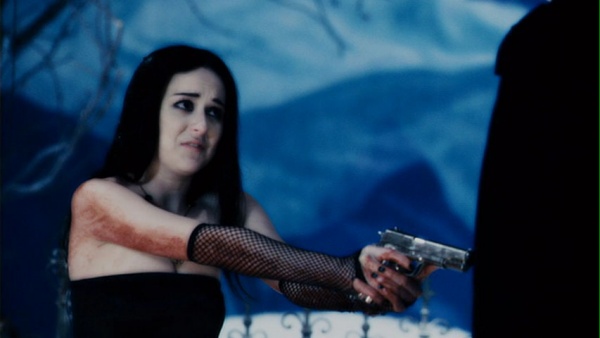


     Spoilers again, if you didn't read, or ignored, the first two (one must cover all their bases, mustt one not?); at the end of Repo! Shilo has discovered that her father is the Repo Man, Rotti Largo, owner of Geneco, has called for the Repo Man to kill Blind Mag, Shilo's God Mother (who took her own life instead), and Rotti has put out a call to destroy Nathan, who wants to kill Rotti for stealing Shilo from him.  Rotti offers Shilo the chance to inherit Geneco (he's dying and his children are human garbage fires), but she can only cash in on the inheritance if she kills her father.

     Rotti then reveals that Shilo was never sick to begin with, but that her father poisoned all her "medicine."  He insists that she fight through the pain when she starts to redline, and she passes out.  When she wakes up, she's cured.

     She decides she can't kill her father, she's not a murderer like him, and Rotti shoots him instead.  Rotti then dies as well, and Shilo comes to the conclusion that no one is a slave to their genetic code and we all have the power to choose what we are, in the aptly named song "Genetic Emancipation."

     She then walks out of the opera house and vanishes into the night, the thesis properly answered before the Graverobber jumps in for the last stasima to hammer home a moralization about grudges gone too far.

     This is great, wonderful, beautiful, perfect.  I love it, I admire it, I ADORE it.

     Except--for Shilo's illness.


     The reveal that she was never sick is super dramatic and says so much about the depths of Nathan's twisted need to keep what he loved locked away from the world for only him to see.  From that perspective, it's a great choice, a very dramatic, unexpected, welcomed twist.

     But it means that Shilo is totally free of her "genetic" burdens--in fact, she never had a genetic burden, just an abusive father.  It's a cure narrative--subverted and wound around a nail, but a cure narrative nonetheless.  Worse, it's an easy cure narrative--she didn't do anything to earn or fight for it, she just denied herself medical treatment, passed out, and woke up better.

    It really weakens the message of the film.  It's supposed to empower and tell us that we, too, can be free of our genetic worries, that our lives are in our hands and we can do anything and shed our blood ties like water from a rainslicker.

     But Shilo's ties are gone--she has no kin left to shame her, just their memory, and she doesn't have to worry about being sick anymore.  She didn't even cut any of her own ties, they were all cut for her.  Despite her insistence that everyone has a choice, Shilo never did--all those decisions were made for her.  On top of being cured, it wasn't even done with any agency.  Had she figured it out for herself, or devised a cure on her lonesome, or even with help, had she done something, anything to cure herself of her disease, I would probably be a million times less upset, but like many narratives based around disabled people and teenage girls, she was deprived of her choice and agency in the matter.

     So for someone who still has to deal with the viruses in my genetic code every single day of my life, who relies on my medication just to make it through the day, someone who can maybe run away from my family if I want to but can never cast off the broken strands of my DNA, the ending rings hollow.  It feels like Shilo has no leg to stand on.  Her "Genetic Emancipation" is closer to a Phenotypal Emancipation, a Poison Emancipation, a Parental Emancipation--her triumph isn't over her veins except in the sense that she's eradicated what's lurking therein, and, again, she didn't even work for it.  She only had to sit and not take her meds.

     .....  Which, now that I think about it, is a really fucked up thing to leave as an example of the "right" thing to do.  If Shilo had still been sick, she would have died.  Not even figuratively, ignoring her medication like that could have straight up killed her, or at the very least caused some serious damage by the time they got her to a hospital.


Take your meds, kids.

     It also intimates that those of us living with these disorders are somehow lazy or cowardly--being cured is so simple, you don't need medication, you just need to get back to your roots and you'll be better in no time!  Just take the magical one-time-treatment cure-all and everything will be fine, you'll be all better!  What, you're still sick?  How can that be!?  Well, you're just not hoping hard enough, if Shilo can be cured after passing out for two seconds, why can't you?


     With her illness looming over her and a continued need to procure and take her meds, the ending would have been a little more of a downer, sure, but it would have been more powerful for a girl still struggling with her condition to announce herself emancipated--bound to her genetic code, maybe, but not a slave to it, able to make her own decisions even with her limitations.

     I would have loved to see a sick Shilo tell everyone that they were free, because sure, it would be a different kind of free for her, but it would be an authentic free, and for those of us who live with chronic illnesses and other disabilities, freedom is of a different sort; I want to hear it said that we do have limitations, but we can still go chasing flies.

     It would also be important to show that for Shilo, her biggest obstacle is her father rather than her disease, which is sometimes the case with real disabled people--it would all be much more manageable without overprotective or under-sympathetic family members getting in the way.

     I have limitations, but I can still catch flies, and stand on the balcony, and every once in a while, when I'm feeling good, I can go to that opera, damn it.  Assuming that the only happy ending for Shilo is the one where she's no longer sick is an assumption and assertion that the disabled and the chronically ill can never be happy.

     Illness makes life hard, but not impossible--if she had something that was medically manageable, there's no reason she couldn't have had a happy ending anyhow.  It's not even like the ending was terribly optimistic, either--a sheltered teenage girl walks off into the night in a crime-infested city in a post-apocalyptic world with no friends or family left alive.  Her best bet is already with the Graverobber, and seeing as he has great connections, no qualms about getting what he wants from dangerous places, and a crush on our heroine, I'm sure he would have been happy to supply her with the medication she needs.  Though perhaps at a price....

     BOOM!  Sequel.  Eat your heart out, Darren Smith and Terrance Zdunich.


     Look, I love, love, love this movie, to the stars and back!  But it has its flaws.  On its own, this ending would even be clever and cheerful, but stacked together with other cure narratives (of which there are thousands), it sends a pretty harmful message to the very people it's ostensibly speaking to.
  
     And maybe that's the problem--this story, written about a girl with a genetic blood disorder questioning what it means to be bitch-slapped by your genetic code, wasn't really written for us, the people who actually live with this very conundrum every day.  It was written for the people who worry that they'll become alcoholics like their dad, or make the same mistakes their mother did, or die at age fifty because that seems to be the family curse.  And that's fine!
     
     It's just ... sad.  

Friday, March 18, 2016

Maggie C's 7 Commandments For Writing Diversity


     White cisheteronormative wealthy able-bodied, neurotypical males; we all know how to write 'em and they're not hard.  They're literally the most vanilla character to write and read about, and yet we keep cranking 'em out like they're Mountain Dew and we're Bros and/or emotional teenagers dealing with their problems by self-medicating with sugary beverages in an effort to not completely destroy themselves while they self-destruct.
     And I get it.  Writing diverse characters is a scary prospect.  It's not as difficult as we make it seem when we talk about it--it's work, yes, but it's not like you're driving screw drivers into your eyeballs in an effort to excise your spleen.  You're writing about a person.  And writing about people is kind of your job, friend.
     I don't pretend to have all the answers.  I'm an eighteen-year-old with no current profession pursuing an education and career in the arts.  What I have to offer are my own life experiences, the research I've done, and fifteen or so years of experience writing fiction.  I'm not perfect, and I can only do so much.
     But diversity in fiction is important to me.  It's supposed to be the goal of an artist to reflect real life, to, as Shakespeare hath proclaimed, "hold as 'twere the mirror up to nature, to show virtue her feature, scorn her own image, and the very age and body of the time his form and pressure."
     Modern art doesn't even reflect half of the human experience.  It's white-washed and full of narratives about the wealthy and/or middle class, usually about men trying to succeed and/or get their dicks wet.  When women are included, it's usually as props, or as thin paper creatures that don't really know what they want until a man comes and tells her; when LGBTQ characters are involved, it's usually G, sometimes L, and the entire narrative typically revolves around how difficult it is to be queer, or else they become a stereotypical gag; when a person of color is included, they usually have few speaking lines, or are also stereotypes; when a person with disabilities is included, it's either a cure narrative or an acceptance narrative or a pity-me narrative, and they're usually a stereotype.  By and large, diverse fiction these days is largely made up of stereotypes people pass off as characters to try and reach some sort of quota, and it's not good enough.
     I've been writing fiction featuring diverse protagonists since I was eleven.  I've learned a lot, I've unlearned a lot, I've done a lot of research, I've done a lot of research that negated that research, I've done a lot of researched that negated the negation of that research--and I've come to develop a personal code to write by, compiled here for the first time ever.
     Maggie's Laws of Fiction Diversification:

6.  Thou Shalt Never Assume That You Know Everything: Do Your Research

     Never assume that you're qualified to write a story about someone or something you don't fully understand.  Even if you think you understand it, do some research; trust me, you'll benefit.  Find some surveys, get books out at the library, read articles online, binge relevant tv shows on Netflix, spend hours scanning relevant pages on Wikipedia and eye-guzzling related tropes on tvtropes; the more you can take in, the better equipped you'll be, and the closer to the source these things are, the better.
     Read articles straight people write about the gay experience, sure, that'll help you write relationships between gay and straight people, but always give more credence to first-person reports, because in the end, no one knows something as well as the one who's lived it.  Abled people can totally understand and sympathize with disabled experiences--they just usually don't, and they'll never be as intimately familiar with the teeter-totter of acceptance and resentment, or societal stigma, or the physical/emotional sensations as someone who's lived it.  Any source is valuable, if only because it gives you some idea of how different people see the issue in question, but some are more credible than others.
     And no, that stuff you learned in school about the Civil Rights movement is not enough; I could go on forever about subpar nature of the public school system, but suffice it to say you have an internet, so use it.

5.  Thou Shall Ask Questions; Get Involved

     Routinely ask yourself questions as you write; is this respectful?  Is this accurate?  Does my research support this?  What do other people think?  Is this portrayal stereotypical?  Is this stereotype justifiable, or would people take offense?  Don't be afraid to reach out to people who know what they're talking about and ask questions or contribute to discussion; follow @WeNeedDiverseBooks on Twitter, or keep an eye out for the #DisChat tag, follow authors that frequently discuss life as a marginalized person, and don't be afraid to DM someone from an advice blog or an advocate who welcomes questions (such as myself).

4.  Thou Shall Get Betas

     Okay, so you did a great job, you used your research, you asked questions, that's wonderful; now get Betas that belong to the groups you've casted your characters into.  You protagonist is a black paraplegic?  You should have both black and disabled CPs/Betas, paraplegic if at all possible.  You may not be able to find a beta or CP for every demographic you cover, but the closer you can get, the better--and absolutely do not assume that you don't need this step.  You can do all the research, avoid stereotypes like the plague, and still make a mistake--it could be something simple and stupid, a mistranslation of a language you don't really speak, you used the name of the wrong tribe, you used a term or grammatical structure that only seems offensive to the people to whom it would actually refer.
     There are a lot of things you can get wrong and never realize, and a lot of other people might not realize either--which is why it's important to fix them before your MS goes anywhere near print.  Just because most people won't notice doesn't mean it's okay not to fix it.
     Make sure the right people are betaing your work.

3.  You Will Get It Wrong

     It's inevitable.  No matter how much you rake over that MS with a fine-toothed comb, you're gonna fuck it up somewhere along the line.  It's inevitable.  That's why we have CPs and Betas and Editors and Agents and more Editors and Publishers and more Editors; humans err.  That's kind of our thing, and it's to be expected.
     You're gonna fuck up.  Just like I fucked up the 10 Commandments theme right here right now.  That's life.  Sometimes you screw the pooch.
     Don't let it get to you.  Don't let it scare you.  Every mistake is something to learn from, a lesson you needed but just got a little late, and it's okay.  As long as you don't close yourself off and insist that you're infallible, things will be okay; you'll figure out where you went wrong, apologize to whoever you offended, and get it right the next time.
     Also:  If you've done the research and you did your best, anyone who screams at you for making a mistake isn't worth your time.  Listen to the people who critique your work, but don't bother trying to please everybody because

2.  Someone Will Always Be Offended

     There was that "Trans-Ginger" episode of South Park a while back that stirred up quite a controversy; I knew a lot of trans people who were really pissed off about it, but I also knew some who were really pleased with the way it turned out.  Likewise, I'm sure there were people who were offended by the South Park episode featuring Tourette's, but I personally have found it to be the most accurate depiction on television I've ever seen.
     I've also seen a number of cases where people were offended by someone's story only for it to come out that the experiences of the marginalized character were based off of the experiences of the like-marginalized author.  Actually, that one's not uncommon--I can't tell you how many times I've seen long, drawn-out arguments on Twitter break out because so many people don't want to hear autistic stories written by autistic authors.
     Point is: there's always going to be someone who likes what you write, no matter how terrible, and no matter how factually and emotionally accurate, there will always be someone who takes offense.  You can't let it get to you.  Consider the reactions of your audience, take them into consideration, ask yourself if you could have done better, but if you honestly wouldn't change a thing?  Don't sweat it.
     I, for one, fully expect people to be offended by the way I write characters based off myself.  I certainly won't like it, but I expect it.  That's how the internet often works these days.

1.  Everyone is human

     As I see it, this is the most important thing to remember when writing diversity--no matter who they are, no matter what they look like, no matter where they come from or what their motivations or limitations are, this character you've chosen to create is a human being.  They have thoughts and feelings and hopes and dreams; they are three dimensional, with hobbies and passions and friends and complex relationships with those friends or families and hopes and dreams; they're the best at something, they're the worst at something, they're decent at some stuff, they're bad at other stuff, they have things they do for profit and things they do for others and things they do just because it makes them happy, they have virtues and vices, talking points and flaws.
     Your characters are not just what makes them diverse, and forming their entire arc around that one (or those multiple) thing(s) is a failure on your part as a writer to impart life into your character.
     Before anything and everything else, I make sure that my characters are three dimensional; the rest will follow.  People are people are people are people, and that's what it all comes down to.  You might get things wrong--your research might be from the wrong sources, you might have conflated two groups on accident, you might have played into stereotypes without realizing it, and if that's so, you fix it--if you can--and apologize and learn from that mistake; you make better decisions next time.  But at least you'll know that you created something real.  Maybe not perfect, maybe not fully accurate, maybe not what everyone wanted!  But you didn't steal away anyone's humanity in the process.

0.  Do No Harm

     I don't do stereotypes; I don't half-ass my research; I don't pin "types" into certain categories, and I try my damnedest to make sure that I'm not accidentally demonizing diversity (and since I have a soft spot for writing objectively terrible, immoral, and amoral protagonists, I have my work cut out for me) or giving in to harmful tropes and plots.
     As writers, we have an obligation to be honest and hard-working, well-researched and goodwilled, because artists determine the fate of mankind.  That may seem a little overdramatic, and maybe it is, but who would you say has been most influential to you over the course of your life?  After your parents (for good or for ill) and possibly your siblings or extended kin, it's probably an artist--a writer, a movie-star, a photographer, a director, a comedian.  Artists have immense power in this world--we are the voices children are listening to, we are the modern philosophers.  Science teaches kids the how and the what; we deal with the whys.
     Doctors and psychologists take an oath to Do No Harm, and it's my firm belief that it's our job to do the same.  We can't promise we won't accidentally do harm, but we should strive, at all times, to make sure we aren't making life hard for ourselves, our kith, our kin.
     Art is exceedingly influential, and we should never use that influence for evil.

Thursday, June 4, 2015

A List of Things People Will Say to you When you Have Tourette's


     I love it when people ask me questions about my disorders.  After all, Tourette's and Fibromyalgia aren't exactly common, and I know how important it is to teach people about such things--if you destroy ignorance today, it could save a life tomorrow.

     So when people work up the courage to ask about how things work or feel, I'm almost always thrilled!  I love teaching, I love learning, and I love open, fearless discussions about the realities of life, peeling back the layers of stigma and ignorance that do nothing but fester when left opaque and undiscussed.  Transparency, in this case, is a good thing.

     But there are certain things that are said to someone with Tourette's that don't fill me with the warm fuzzies, things which are best left unsaid.  While I'm glad that I was able to address some of the things that have been said to me before they reached the ears of anyone else in the same boat, I'd appreciate it if anyone reading this didn't make the same mistake--unless, of course, you put them in the mouths of your characters, in which case it might add a touch of realism to the story.

  • "What's that disease you have?  Can I catch it?  Is it safe to drink this?"
     
         Tourette's is NOT a disease.  It's a Syndrome, a disorder, a disability, but it's not a disease or an illness, a virus or bacteria or infection.  It cannot be caught or contracted, and the worst you'll catch if you drink from my water bottle is probably a sore throat.  

     
  • "Have you tried medication?"

         Yes, actually, I have.  But as I've mentioned in other posts, due to low visibility and nil fatality there aren't any medications designed specifically for Tourette's Syndrome; the best you'll find are seizure medications, many of which can be very cognitively suppressant and/or harmful to your heart.  Clonidine is just about the only medication that does neither, but it's used primarily to treat ADHD, and didn't help me at all.
         The problem with this question is multifaceted; firstly, it implies that neither I, nor my family, nor the myriad of doctors I've been to have ever considered looking into medication.  Unless you're a homeopath, trust me when I say that medication is the first thing you think about when you're diagnosed--sometimes before you're diagnosed!  The better question would be "Does medication work?," the answer to which would be no, most of the time it doesn't.

         The second problem with this question is that it implies that medication is necessary.  For something like Tourette's, medication can sometimes help manage tics, yes, and if you have very severe tics or a particularly misunderstanding set of peers it can put you in a much greater sense of comfort.  But because it isn't deadly, there isn't a driving need to use it if you don't want it, and most people who ask this don't really care about the comfort of the afflicted individual--they care more for their own comfort and sense of worldly normalcy.
  • "Can't they put you in a coma?"
       People have said this to me.  Please, take a second to think about this; human beings have approached me, called me by name, and very openly and genuinely asked me if (or told me that) a medically-induced coma could be a solution.  I honestly don't know where this comes from--what would that solve?  What would it change?  I think it just links back to the prioritizing of one's own comfort above the comfort of the afflicted individual, but to a new kind of extreme--imagine if you started coughing and someone came up and told you that your cough was so annoying that you needed to be locked in a closet for an indefinite period of time.  Yeah.  Not a great feeling.  

  • "I wish I had Tourette's!"

      No.  No you don't.  You really, really don't.  You don't want the stares you'll get in public, or the ableist comments from your peers, the cruel nicknames people think are funny, or the way half the population doesn't even believe that what you have is real.  You don't want the loss of bodily autonomy or the mental illnesses that usually come hand-in-hand, and you absolutely do not want to be yelled at by police officers in the driving rain, or teachers who tell you you're lying when you try to explain yourself, or substitutes that were never told about your condition.

       You just really don't want this, so don't act like you do.  I know you mean well, but you clearly have not thought this through.

  • "If I had Tourette's I'd swear all the time!"

         Well yes, maybe you would.  Or maybe you wouldn't have coprolalia at all, like ninety percent of people with Tourette's Syndrome.

         I'm also often asked if I ever swear on purpose and use my Tourette's as an excuse, and the answer is always no.  Yes, I swear, and yeah, having coprolalia has made me pretty callous about it--if I'd continued to care about it after it started I'd be in a pretty bad place, so the best thing for my own mental health was to embrace the practice and take a little control back.

         But never once have I used my Tourette's to excuse my own words.  When you have Tourette's, there's a separation that happens in your mind.  You delineate between "Me" and "It;"  Me and It are always battling for control over mouth and body, and you feel the need to protect the Me, to take credit where credit is due.  You learn not to feel pride or shame for what It does, and instead focus your energies on how Me functions.

         I cannot control it when It swears at my teachers, but I CAN control it when Me swears at teachers, so Me keeps its mouth shut where applicable; I've had tics that keep me from talking and tics that keep me talking, so when dealing with Tourette's silence is as much a weapon as speech.
  • "You're just faking."

         Also, see; "Tourette's is fake" and "Stop it anyway" and "No you don't" for varying degrees of ableism.

         This is one of the worst things you can say to someone with Tourette's--or any disorder, disability, or illness, really. With Tourette's it often connects to the comments above--people are only faking so they can swear, after all, never mind that tons of children are injured by or beat up for tics every day that have nothing to do with cursing.  Tourette's is hell enough without the disbelief that accompanies it.

         I've also been told stories about kids that were faking it, like it hurts my case to have someone else screw up--not that I know they screwed up in the first place.  The story I best remember is one in which my sister-in-law's stepfather walked in on some of his students talking about how "awesome" it was they got to swear in class, at which point he told them that if they ever swore in his class again they'd see their comeuppance.

         My question, of course, is how does he know they weren't just trying to make the best of a bad situation?  That's kind of the status quo of the disabled.  "Look at this awful thing I have to deal with!" we say, and everyone says "Shut the fuck up you whining loser!"  "Well I guess at least I don't have to do gym anymore," we mumble, curling up into a ball.

  • "You don't know what it's like to lose control of your life!"

         Of all the things that people have said to me over the years, I think this one is probably the one that pissed me off the most.  A girl I had known for years turned to me in the lunch line and said this to my face.  

         No, I don't know what it's like to lose control of your life.  I mean, I can't control what my arms and legs do, I never know what my mouth is going to do next, my emotions might as well be tied to the movements of the Earth around the sun and the moon around the Earth, I had to give up almost half my personality in response to and in order to cope with my disorders, and for two years I had to give up my personal passions because it was too exhausting to try to juggle Tourette's, Fibro, and plays, but yeah, no, I have no idea what it's like to lose control over my life.  None whatsoever.

         Never fucking say this to anyone with a disorder.  Never.  


         So there's a list of a few things people might say to you when you have Tourette's.  If any of my fellow Tiquers have anything they'd like to add or share, or if anyone has any questions, feel free to comment!   I'd love to hear your stories and answer your questions.

         If there's anything you've thought about saying to someone you know or any questions you've thought about asking, and you aren't 100% certain that it's appropriate to ask them, don't be afraid to send me a message instead, especially if the two of you aren't that close, and I'll try to be gentle with you no matter the outcome.  I'm not trying to dissuade you from sating your curiosity, but I am trying to protect other Tiquers from the damages of thoughtlessness and ignorance.