Tuesday, June 16, 2015
On Picking A Title
Choosing a title for your story is a big responsibility. It's the first thing most people will notice about your book, and, let's face it, when was the last time you picked up a book with a terrible title? It's hard to sell a thriller novel if it's called "The Wacky Fantastic Journey of Silly Sam and his Funtime Weasels," or a children's novel entitled, "KILLZONE SEVEN: THE RE-MURDERINATING."
Titling isn't just as simple as choosing something that sounds nice, either. You can have a really nice title, and it may not be right for your work, and you can have a very accurately descriptive title, and it might be too clunky--even when you think you've got it all figured out, you might still have some work to do. It never hurts to take another look! Here's some of the many, many methods that exist for choosing a title. (I call it: *Dramatic announcer voice* LISTICLE 3: A LIST TO THE LEFT)
I. Compiling a List
1. Isolate the main themes of your story
What is your story about? The struggle between good and evil? The appalling nature of America's treatment of minorities? The difference between looking both ways before crossing the street and sweet, juicy, death?
Whatever it is, hunker down and write a list of all the words you can think of that pertain to your theme, even if they're only related tangentially. Also, write down any symbols that might occur--sometimes great titles can be made of symbolism. Make the list as long or as short as you want. Do any words jump out at you? Any combinations of words? Write down whatever combinations seem to best describe the story. Keep those around. If you're still not sure you like what you have...
2. Consider your characters
If your story is pretty character-driven, you may want to consider using your characters to name it. You could use a character's name (or several), or you could make another list (it's a list-heavy article. Strap in, kids, it's gonna be a bullety ride) of words related to your character--traits, triumphs, defeats, arcs, character changes, colors--anything goes! Then, again, pair things together. Experiment! Write your favorites down on your To Seriously Consider List (TSCL).
3. Are there any recurring gags or sayings/events that could be used?
Especially in a humor novel, naming your book after a recurring joke can be a big hit--if you name it after the right one, everyone is going to be associating the line with your book anyway, so why not capitalize on it? In a more dramatic novel, a particularly striking line from the book, or a common phrase--twisted or played straight (Live and Let Die vs. Catch 22), a certain level of familiarity can catch both the eye and the imagination. Make another list, then pick your favorites and add them to your TSCL.
4. Are there any poems or songs that fit your book?
I often name my books after fitting song lines or titles--if it fits the book, then most people won't realize, and the ones who do will get a total kick out of it. Plus sometimes music is the best way to describe a thing. Throw a few on your TSCL and prepare to examine their worth!
II. Refining your list
1. Take a look at your TSCL.
You probably have a lot of options left over; first thing's first, go through and divide your titles into the four categories above. Go down each list and mark them S (strong) M (moderate) and W (weak). Can you strengthen or save the weaks or moderates? Get rid of the ones you can't; fix the ones you can.
Check each list and decide if any of the above methods don't, for whatever reason, fit your story. Does a song title seem too gimmicky? Are you adverse to naming a book after a character? Eliminate categories as you see fit.
The rest you can eliminate using these criteria:
2. Does it fit the tone/genre of your novel?
I don't go too much off genre conventions myself, but it IS important that you don't confuse your reader--BIG FANTASY NOVEL XXX isn't a title that would grab the attention of a chaste group of sci-fi nerds.
You also don't want a title that doesn't fit the tone of your novel, and I think this is the big one. The Grapes of Wrath doesn't sound like a comedy, and Love Story doesn't sound like a book discussing a revolution; if that's what the authors were going for, they would not, by any means, have been as well received as they were. You may not want the audience to know absolutely everything about your story just from looking at the title, but it's the first step in deciding you want to buy a book, and as such, it should never be a liar. Rule out anything that doesn't fit.
3. Does your title mean something?
Titles are often most powerful, and have the most staying power, when they possess a double meaning, and can be viewed one way at the beginning of the novel, and another at the end. It may mean many things, or, as I suggested above, be a literal symbol that appears in your novel. Of Mice and Men, for instance, is named after a line in a poem--"the best laid plans of Mice and Men often go awry," which relates strongly to the recurring theme of the death of dreams and failure of plans in the figurative wasteland depression-era America was (the entire story is about two men who plan to get the money together to start a farm, only for one of them to SPOILER ALERT end up dead, the other with no will left to start the farm on his own). But it can also be seen to refer to the relationship between Lennie and the mice--soft, fragile things, which he loves but always kills--a very important element which foreshadows the death of both a puppy and his employer's wife. These things you realize only as you get deeper and deeper into the novel, but it works.
Your title doesn't have to have two meanings, but it can definitely add some depth. Play around with it, see what you can find!
4. Don't be afraid to go simple
sometimes Simple is Best--capitalized and lowercased for emphasis. Carrie, The Hunger Games, The Hobbit--all very simple, very successful titles. The big flashy titles are great, and can do a lot to capture a reader's attention, but sometimes it's best to allow the story to speak for itself. Name it after a character, an in-world social structure or event, a county, a planet, a species--whatever's best for your book. Sometimes bigger isn't better.
III. Test Your Title
1. Is your title original?
Take this new and exciting title and slam dunk it into Google or Amazon--if another book comes up by the same name, this probably isn't the title for you. While it's perfectly legal to use the same name as another book, it's not a good idea just based on the public aspect of it--if the other book is spectacular and has a large fanbase, you wouldn't want your book to be buried under the avalanche of praise for the other book, and if the other one is terrible you don't want its reputation to bring you down.
It's impossible to be completely original, but you should still do your very best to try.
2. Does it fit your story?
Be honest with yourself; did you choose this because it fits your plot, your characters, your world, or because it sounds cool? If it's just because it sounds cool, go back to the drawing board--pick one that's cool but actually pertains to the story being told. Don't lose hope; your title is out there.
Look again at the tone of your novel. Make sure it fits--or, if it doesn't, that it's purposeful. Sometimes a misleading title can work, but only if it's done with a lot of forethought and not by accident.
3. Sit on it
In writing, we spend a lot of time sitting on things. Literally and figuratively--there's a lot of sitting involved in writing or typing, but you know what I mean.
When you have a refined list of titles (or just the one), let them stew a while. Name files after them, jostle them around in your head, reread the story with that title in mind. After a week or so, you'll probably know whether or not you like it. Maybe you'll grow attached!
Whether you become partial to one or still have it up in the air, don't forget to ask yourself;
4. Does it resonate with people?
Pitch your title to your friends and family members, followers, classmates, even strangers. Ask them their opinions--would they read a book with that title? At least check the back cover? Does it stir up any positive or negative emotions? Do those emotions fit the tone of your book?
Explain the plot and ask them if they think the title fits. Do they have any suggestions? Don't take their critiques to heart, but do take it to mind, especially if they're critique partners or betas--keep a log of what they say, and analyze it to see if you think it holds water.
Ultimately, this is your decision--NO ONE knows your book better than you. But it can definitely help to get a fresh perspective.
Picking titles can be difficult, especially when we think we know what we're doing. If you find that you've made a mistake with your working title, don't feel bad--I once called a superhero novel about a villain named Labrynth (spelling intentional) and a hero named The Extraterrestrial The Extraterrestrial In The Labrynth for a year while I wrote it, because until I had finished it, read through it three different times, and given serious thought to the plot, it seemed like a good idea.
It can take a lot of time and effort, but landing on a good title is worth it--for you, if for no one else. It can help pull a book together, give it a sense of identity--it's no longer that novel I've been working on--It's The Great Capibara Adventure, The Amazing Trimalchio, Escape From Calcutta! A good title can even be the difference between an agent's desk and the slop pile.
If you've already spent ten thousand hours putting your book together word by word and edit by rewrite, don't you think it deserves that extra 5-10? Every story wants to be finished. Let yours live its dream.
Labels:
Characters,
How To,
How-To,
Lists,
Names,
Plot,
Stories,
Titles,
Writing,
Writing Advice,
Writing Tips
Sunday, June 14, 2015
#SueQuest: Questioning The Validity of Mary Sue
The other day, trying to find a control to use for The Mary Sue Litmus Test (for the sake of a blog post, you see), I asked my friend Rebekah if I could use her, thinking that she, a real person, couldn't possibly test positive for Mary Sue. I started asking questions, and Rebekah and I ended up turning it into something of a game, then into a livetweet session, which we lovingly entitled #SueQuest.
But the more questions we answered, the more it seemed like my friend truly was a Mary Sue--something straight out of a bad high school drama, almost. Even with a metric fuckload of desuifers, she ended up scoring a forty-five--five points away from "BURN IT AND RUN!" territory!
It seemed hilarious, of course, but it really got me thinking. Thus, I tested myself--and I also came out a Mary Sue, with 43 points of Sueness! And this is without answering any of the "Is this character named after you?" type questions. In fact, the only person I tested who didn't end up a Mary Sue was my dog, Amy--and she still had 27 points, placing her in the "be very careful" range.
She is little more than a very tiny bug.
I'm not about to say that this means anything--certainly not anything concerning Syera Miktayee, whose website I enjoy and frequent quite...um....frequent...ly. Shut up. It's not like it's just this one test--Rebekah and I came up a Mary Sue on every test I could find.
But it does remind me of a few posts by the women down at Rewriting Mary Sue, and some points that have been made--how the term Mary Sue began as a term for bad fanfiction author inserts who bent the entire fabric of the universe to their whim so that things would turn out well for them; for whom there was never any question of winning, for whom the best always occurred, the worst flitting through only briefly, trivially, and with great contrivance; but how it has now come to mean any character who happens to have too much power or be too good at too many things--and the fact that the term is disproportionately leveled against females.
As Jenn Lyons pointed out in one of the above links, male characters have to be so Mary Sue that they're freaking SUPERMAN before anyone will call them a Mary Sue--or Gary Stu, if you prefer the more masculine term. When a man is Batman, he's Batman; when a woman is Batman, she tends to get slapped with a citation.
One of our goals as writers is to create realistic, three dimensional characters that still manage to be out-of-this-world fantastic--most of us don't read superhero stories to see how regular "normal" people are processing the events. We read superhero stories to watch people with amazing abilities overcome impossible odds using their incredible talents!
But how can we ever expect to see realistic, three-dimensional characters if two American teenagers from the real world (without superpowers, I might add) register as Mary Sue right off the bat? I definitely agree that characters who bend the world to their whims are a problem, as are overpowered, unflawed characters (though the term for this, I was originally taught, is God-Modded), but I think this is something definitely worth considering the next time you decide to trash a Mary Sue. Do you have a problem with this character because she doesn't have realistic flaws, because she makes things stop making sense? Or do you dislike her because you think she's too smart and too beautiful and too talented all at the same time? There's an expectation in society that women are to be only one or two of these, never three, and never, ever any more than that.
If you're ever in doubt, play the sex-swap game; if you make this character a man, do you have the same reaction? If you compared her to a male superhero, how does she rank? Is she really as bad as Superman? Or are you just upset that this portrayal of a woman is going against the grain of the stereotypes you've been taught to separate them into?
I encourage you all to play the #SueQuest game; test yourself, your friends, your family--just don't forget to tag it if you do, so I can see what your outcomes are! What are your thoughts on Mary Sues? Feel free to discuss your Sue Views or deconstruct some characters in the comments section!
Thursday, June 11, 2015
Am I Allowed To Write?
Feeling like we're allowed to write can be hard sometimes, especially for new writers, so today I'm answering a couple commonly-asked questions about what it takes to be a writer (in vivid and graphic detail, of course).
How Old Do I Need To Be to Start Writing?
Any age, so long as you have at least a basic understanding of language.
Do I Need To Have a Degree to Be a Writer?
No. No degree or certificate is necessary; just a love of words.
Do I Need Permission to Write?
No.
What If I Feel Like I Need Permission?
Then I am giving you permission. Now go, friend; write your masterpiece.
But--
Shhhhhh. No buts. Only writing now.
Wait. I Write! Am I a Writer?
Aye, comrade. Welcome! May your days be write-tastic and your hard drive never fail!
Monday, June 8, 2015
The Importance of Fanfiction
The first story I ever wrote was called "The Hecatense Goose;" I was three and could neither read nor write, so my mother wrote it down and it was eventually lost. I have no idea what the story was about.
But my second story was a series of scribbles that told a tale of Peter Pan's post-Hook adventures, and my third was a sequel to the then-unfinished Series of Unfortunate Events books. At the time I did not, of course, know anything about fanfiction or copywright laws, but since then I've done a lot of growing as a writer--yet still fanfiction calls to me.
It's a polarizing issue. As a once-B-rated-star of the Megamind fandom, I am very biased in favor of fanfiction, because it's fun, it's flattering (I can't think of anything better than having such a wide fan base that they take inspiration from and write about your world and characters! How great would that be?? ((Super great is how))), and reading/writing it can help you grow as a writer.
Here are a few ways it's beneficial to a writer.
Fanfiction can....
1. Be great place to start
At any level of writing skill fanfiction is great practice, but it's especially good for beginners, since it allows you to create stories with pre-established characters in a pre-established world, often in a pre-established style, which gets you comfortable with developing plot, using detail to your advantage, and using correct grammar, spelling, punctuation, and format.
Once you're comfortable with the writing basics, it's easy to rocket through the ranks, stepping up one rung at a time rather than going in all at once--you start deviating in style, then move the characters from one world to another, and finally start creating OCs (usually either using author inserts or child-of-PC characters at first). Before you know it, you're creating fanfiction that's only tangentially related to the original story--sometimes barely related at all.
When writing original content there's a very sharp learning curve--you essentially go from zero to three-sixty in nothing flat, but fanfiction allows you to build at a pace you're comfortable with, without feeling pressured to be your best most original self right off the bat.
2. Offer a source of feedback
One great thing about fanfiction is that, at least when published online, it offers you a source of feedback through the fandom. When you do well, this means instant gratification, which can make you feel amazing, but arguably the more valuable form of feedback comes in the form of constructive criticism and suggestions from the audience. You learn a lot about spelling and grammar--always useful--and even more about story structure and character development.
Whether what you're writing is offensive, or just poorly executed, it's always nice to have eyes on your words, people who can tell you when your characterization is inconsistent or when you need to plug a major plothole or if your "super secret" ending/plot twist is visible from a mile away. And while beta readers and critique partners are great after the fact, feedback from the community usually occurs as you publish each chapter, which allows you to make changes as you go forward rather than having to double back--and by implementing changes as you go forward, you'll remember to implement them in future projects, too.
3. Be inspiring
Fanfiction is great even if you don't write it. Just reading fanfiction can be inspiring, as I mentioned here; good fanfiction makes you want to run out and write a story based on X idea or Y character arc, and bad fanfiction makes you want to write something amazing just to prove to yourself that you can do it. It's a good idea. You should do it.
4. Give you a sense of accomplishment
Fanfiction is, I find, relatively easy to produce--there's a lot of work that's already been done by the original creator, which means that a lot of your characters don't need descriptions, a lot of places don't need explaining, and a lot of events are already common fandom knowledge--yet there's still a TON of work that goes into making a truly quality fic. When you finish a fic, or a fic chapter, it feels amazing--when people respond positively, you feel like you're on cloud fucking eleven; it helps with your sense of self and it increases your confidence, and when you feel good about yourself it becomes a lot easier to make progress on the next or concurrent project.
Progress begets progress, so sometimes it's great to use a little project (like a fanfic oneshot) to jump-start a larger project--like a couple thousand word down payment on your new MS.
Plus, again, you feel really great, and who doesn't like feeling really great?
5. Community
Because the entire basis of fanfiction is that you're writing in a world someone else has created, the people you're trying to reach are already fans of what you're watching/reading, and, as fandom flocks together just like birds of paper feathers, you're not just pitching to individuals but to a ready-made community.
One of the best ways to become a fully realized member of a fandom community (and through doing so find a place where you belong, people to help you in your quest for perfection, friends to see you through until the end) is to write fanfiction (or make fanart but, while I am very enthusiastic about art, this is not an art blog). The more obsessive you are about a fandom, the more fanfiction becomes something akin to a need, and the best fillers of those needs are gods on high for a fandom nerd. If you're fanficcing on the same account where you present your real life persona, it also creates a community that revolves around your work, which can be a great marketing platform when you start launching original content.
6. Make someone else's day
You know you have done your job as a writer when someone tells you that you have made their day. The only thing that even comes close to describing the feeling is "euphoria." This, like before, creates an increased sense of self, a greater feeling of self-confidence, and a driving desire to continue working. Writing is an addiction, and like all addictions, the more you do it, the more you want to do it--and the more people agree with your addiction, the better it feels to give in.
Also...
7. Fear of disappointing your fans keeps you trucking along at a good speed
One of the things I have trouble with is meeting my own deadlines. This is really bad for a writer. I do, however, do very well at meeting deadlines when someone else is waiting for the update with bated breathe.
When I was especially absorbed in the fanfiction world, I could pump out several chapters a week in a good month--sometimes several a day, because when you know people are enjoying your work it, again, encourages you to work more, but it also encourages you to work toward not disappointing them. The last thing you want when you have fans is to lose them. Worse than just losing them is losing them not to your own incompetence, but to laziness, of all things. It's definitely an incentive, and if you smarten up and get organized with your attempts to deliver quality content at death-defying speeds (I didn't), you can put the same updating strategies you use with fanfiction on your writing.
Maybe you have a flow chart, or a friend you can submit chapters to the same way you'd submit to your chosen hosting website--whichever way, organization in one realm of your writing life should definitely lend itself to organization in others, and as they say, an organized life is an organized mind (or something like that), which lends itself to productivity.
8. No limits, no consequences
Addendum: There are no limits in original writing either, and there are some minor consequences to writing (and publishing) bad fanfiction.
hOWEVER; it's easier to write without limits when you're playing with someone else's characters. It feels like there's less to lose--you can't screw it up, because the worst thing that happens if you do is you need to write something else, or maybe apologize for a few mistakes. You're more likely to follow tangents and do silly, seemingly unnecessary things, or kill off or bring back characters at will, playing with the rules when it seems convenient (or refusing to ever play with the rules, whichever isn't your default), which can be goldmines for your creativity. Just because it's not being used in a "real" project now doesn't mean you won't use it later.
There are a lot of pressures fanfiction allows you to let go of, which is important practice for when you need to forget about society while you write your magnum opus. One of the best things you can do for your writing is allow your creativity to run wild, because you can always--and should always--edit later.
The long and the short of it is, fanfiction is amazing. Use it as an outlet, use it as practice, use it just for fun--any way you dice it, it's worth whatever time you do--or don't!--want to put into it.
Saturday, June 6, 2015
A Few Methods for Stirring Up Story Ideas
Sometimes you need story ideas. Sometimes you don't know how to get them. Here's a list of things you can do to try to get your brain moving!
1. Play The Sims
You can laugh all you want, but I once wrote a 500+ page novel based on characters I created in the Sims 3, and the slew of crazy shit that happened to those characters after I created them. The Sims is a great way to get your creative juices flowing--and the more expansion packs, the better.
The Sims allows you to make your own characters (or randomize, if you need help creating the characters, too), and in order to stay interested in the sandbox gameplay you're essentially forced to make up a story about said characters, in your head and sometimes in their bios. There are also dozens of worlds, thousands of trait combinations, and tons of character types to choose from and interact with, which can help you .
There are so many variables in the Sims (with expansion packs, at least) that it's almost impossible not to come away with at least enough inspiration for a short story premise.
I suggest using the Sims 3, but to each their own.
2. Read some one-shot fanfictions
Whatever fandoms you might be into, I pretty much guarantee that, somewhere on the internet, there will be at least one good one-shot. For inspirational purposes, I lean toward sadstuck, since there's a lot out there and a surprising amount of it is well-written (plus I'm a masochist and sad stories tend to resonate with me. And I write a lot of tragedy), but one-shots of all kinds can be rife with ideas (AUs, fluff, smut, friendfics, whatever gets your mind working overtime).
One of the best things about one-shots is that they not only deliver a concentrated punch of idea right to your brain (if you're lucky), they're also rarely longer than five or six thousand words, meaning they don't take up a lot of your time. Longer stories, fanfic and otherwise, are great for ideas, and provide excellent insight into how to execute story and character arcs, but they consume a lot more time and energy than the shorter version.
I also suggest fanfiction rather than short stories (though short stories are great and you should totally read as many of those as you can, too) for two reasons--one, you already know the characters, which makes it easier to immerse yourself in the story and quickens the pace of it (since you don't need to read through a description or question their personality or motives), and two, bad stories can be just as inspiring as good ones, and you're less likely to find published works that stink of amateurism. Have you ever been reading a really bad fic with a really good premise and gotten so angry that you decided to write the same basic fic only a mILLION TIMES BETTER?????? Yeah, that's why fanfic.
3. Watch cartoons
Cartoons are great for the same reason one-shots are great, only usually less weighted down by those pesky laws of reality--I mean, Adventure Time has KNIFE STORMS. When was the last time you read about a world with knife storms? Never? I thought so.
Sometimes the best thing for a writer is to just let go of all sense of reality, especially if you write sci-fi or fantasy, wherein anything can happen. Cartoons are also good if you're trying to write family-friendly content, or if you need help writing child characters (or from the perspective of a child). It can also be great for developing mythologies. Imagine Adventure Time as a pantheon: Princess Bubblegum, creator of all Gods (through science, of course); Finn the Adventurer, God of travel and battle; Jake, Lord of Reality Manipulation; Marcelline, Queen of the underworld. That would be pretty dope, right?
4. Go for a walk
Exercise stimulates brain activity; it can help you retain information, recall information, and develop new ideas. I suggest listening to music while you go out (that's how I get into the zone), but some people do find it distracting, or find that they gain more inspiration from the sounds of nature than from the rhythm of music. Either way, it's also good to get away from all the distractions provided to you by the cozy insides of your teched-up, probably loud house. Plus, you never know what you may encounter on your walk--maybe you'll see a skunk making friends with a bird, or some kids scaling up the side of a house, or witness the encroaching Singularity from a safe distance, any of which could be put to use on paper.
5. Take a nap
I really really really truly do advocate that you try the radical curative powers of some good old fashioned nap. It can refresh your mind and body, restore you to stress-point-zero, and you never know what you'll dream of while you're out. Dreams can be quite the source of inspiration, I am told.
I've also has some of my best ideas while perched upon that precipice between waking and sleeping, so make sure to take your notebook with you!
Are there any other methods you use to stir up inspiration or capture ideas? I'd love to hear them!
Thursday, June 4, 2015
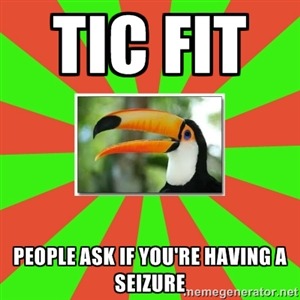
A List of Things People Will Say to you When you Have Tourette's

I love it when people ask me questions about my disorders. After all, Tourette's and Fibromyalgia aren't exactly common, and I know how important it is to teach people about such things--if you destroy ignorance today, it could save a life tomorrow.
So when people work up the courage to ask about how things work or feel, I'm almost always thrilled! I love teaching, I love learning, and I love open, fearless discussions about the realities of life, peeling back the layers of stigma and ignorance that do nothing but fester when left opaque and undiscussed. Transparency, in this case, is a good thing.
But there are certain things that are said to someone with Tourette's that don't fill me with the warm fuzzies, things which are best left unsaid. While I'm glad that I was able to address some of the things that have been said to me before they reached the ears of anyone else in the same boat, I'd appreciate it if anyone reading this didn't make the same mistake--unless, of course, you put them in the mouths of your characters, in which case it might add a touch of realism to the story.
- "What's that disease you have? Can I catch it? Is it safe to drink this?"
Tourette's is NOT a disease. It's a Syndrome, a disorder, a disability, but it's not a disease or an illness, a virus or bacteria or infection. It cannot be caught or contracted, and the worst you'll catch if you drink from my water bottle is probably a sore throat.
- "Have you tried medication?"
Yes, actually, I have. But as I've mentioned in other posts, due to low visibility and nil fatality there aren't any medications designed specifically for Tourette's Syndrome; the best you'll find are seizure medications, many of which can be very cognitively suppressant and/or harmful to your heart. Clonidine is just about the only medication that does neither, but it's used primarily to treat ADHD, and didn't help me at all.
The problem with this question is multifaceted; firstly, it implies that neither I, nor my family, nor the myriad of doctors I've been to have ever considered looking into medication. Unless you're a homeopath, trust me when I say that medication is the first thing you think about when you're diagnosed--sometimes before you're diagnosed! The better question would be "Does medication work?," the answer to which would be no, most of the time it doesn't.
The second problem with this question is that it implies that medication is necessary. For something like Tourette's, medication can sometimes help manage tics, yes, and if you have very severe tics or a particularly misunderstanding set of peers it can put you in a much greater sense of comfort. But because it isn't deadly, there isn't a driving need to use it if you don't want it, and most people who ask this don't really care about the comfort of the afflicted individual--they care more for their own comfort and sense of worldly normalcy. - "Can't they put you in a coma?"
People have said this to me. Please, take a second to think about this; human beings have approached me, called me by name, and very openly and genuinely asked me if (or told me that) a medically-induced coma could be a solution. I honestly don't know where this comes from--what would that solve? What would it change? I think it just links back to the prioritizing of one's own comfort above the comfort of the afflicted individual, but to a new kind of extreme--imagine if you started coughing and someone came up and told you that your cough was so annoying that you needed to be locked in a closet for an indefinite period of time. Yeah. Not a great feeling.
- "I wish I had Tourette's!"
No. No you don't. You really, really don't. You don't want the stares you'll get in public, or the ableist comments from your peers, the cruel nicknames people think are funny, or the way half the population doesn't even believe that what you have is real. You don't want the loss of bodily autonomy or the mental illnesses that usually come hand-in-hand, and you absolutely do not want to be yelled at by police officers in the driving rain, or teachers who tell you you're lying when you try to explain yourself, or substitutes that were never told about your condition.
You just really don't want this, so don't act like you do. I know you mean well, but you clearly have not thought this through.
- "If I had Tourette's I'd swear all the time!"
Well yes, maybe you would. Or maybe you wouldn't have coprolalia at all, like ninety percent of people with Tourette's Syndrome.
I'm also often asked if I ever swear on purpose and use my Tourette's as an excuse, and the answer is always no. Yes, I swear, and yeah, having coprolalia has made me pretty callous about it--if I'd continued to care about it after it started I'd be in a pretty bad place, so the best thing for my own mental health was to embrace the practice and take a little control back.
But never once have I used my Tourette's to excuse my own words. When you have Tourette's, there's a separation that happens in your mind. You delineate between "Me" and "It;" Me and It are always battling for control over mouth and body, and you feel the need to protect the Me, to take credit where credit is due. You learn not to feel pride or shame for what It does, and instead focus your energies on how Me functions.
I cannot control it when It swears at my teachers, but I CAN control it when Me swears at teachers, so Me keeps its mouth shut where applicable; I've had tics that keep me from talking and tics that keep me talking, so when dealing with Tourette's silence is as much a weapon as speech. - "You're just faking."
Also, see; "Tourette's is fake" and "Stop it anyway" and "No you don't" for varying degrees of ableism.
This is one of the worst things you can say to someone with Tourette's--or any disorder, disability, or illness, really. With Tourette's it often connects to the comments above--people are only faking so they can swear, after all, never mind that tons of children are injured by or beat up for tics every day that have nothing to do with cursing. Tourette's is hell enough without the disbelief that accompanies it.
I've also been told stories about kids that were faking it, like it hurts my case to have someone else screw up--not that I know they screwed up in the first place. The story I best remember is one in which my sister-in-law's stepfather walked in on some of his students talking about how "awesome" it was they got to swear in class, at which point he told them that if they ever swore in his class again they'd see their comeuppance.
My question, of course, is how does he know they weren't just trying to make the best of a bad situation? That's kind of the status quo of the disabled. "Look at this awful thing I have to deal with!" we say, and everyone says "Shut the fuck up you whining loser!" "Well I guess at least I don't have to do gym anymore," we mumble, curling up into a ball.
- "You don't know what it's like to lose control of your life!"Of all the things that people have said to me over the years, I think this one is probably the one that pissed me off the most. A girl I had known for years turned to me in the lunch line and said this to my face.
No, I don't know what it's like to lose control of your life. I mean, I can't control what my arms and legs do, I never know what my mouth is going to do next, my emotions might as well be tied to the movements of the Earth around the sun and the moon around the Earth, I had to give up almost half my personality in response to and in order to cope with my disorders, and for two years I had to give up my personal passions because it was too exhausting to try to juggle Tourette's, Fibro, and plays, but yeah, no, I have no idea what it's like to lose control over my life. None whatsoever.
Never fucking say this to anyone with a disorder. Never.So there's a list of a few things people might say to you when you have Tourette's. If any of my fellow Tiquers have anything they'd like to add or share, or if anyone has any questions, feel free to comment! I'd love to hear your stories and answer your questions.
If there's anything you've thought about saying to someone you know or any questions you've thought about asking, and you aren't 100% certain that it's appropriate to ask them, don't be afraid to send me a message instead, especially if the two of you aren't that close, and I'll try to be gentle with you no matter the outcome. I'm not trying to dissuade you from sating your curiosity, but I am trying to protect other Tiquers from the damages of thoughtlessness and ignorance.
Tuesday, June 2, 2015
Things Not To Do During Camp NaNoWriMo
The first half of Camp NaNoWriMo ended nearly a month ago, and I lost by a little more than half my goal. I'm not proud of this, but I'm going to call it a "Learning Experience" and use it to get a blog post in. Here's a list of nine things you SHOULDN'T do when embarking on Camp NaNoWriMo.
- Get sick
I came down hard with a throat virus in early April that really sent me reeling. I couldn't talk, I couldn't move, I couldn't do much of anything. The one thing I COULD do was write--which I did a lot of! I got something like twelve thousand words written in one business week.
But then I had to go back to school, and this is where I died. I had reading to make up, worksheets to fill out, MORE reading to make up, and everything went to hell. I was still sick when I went back, too, which meant that in addition to scrambling trying to catch up with backwork, I was also exhausted just getting up in the mornings, and my favorite thing to do was come home and sleep, which meant foregoing my daily writing for days at a time.
Don't get sick when you do NaNo, kids.
- Buy an iPad
I've never owned an Apple product before, or even a cell phone more high tech than a basic Tracfone, but last month I decided to purchase a used iPad from my boss. "This will be awesome," I said to myself. "I'll be able to write my NaNo Novel anywhere I want and not have to worry about transcribing!"
I did not, you will have inferred, understand how iPads work.
My intentions were good, but one of the first things I did was go online and download a bunch of Apps that looked cool, and some of them actually were. The one I wanted most to work properly, however--the word processor--was lackluster and comparatively difficult to figure out, and I ended up spending far more time trying to make my digi-self a rich famous moviestar in the coolest high school university EVER, which cost me precious hours in writing time.
Since then I've chilled on the games (mostly), and I had a lot of fun but hindsight being 20/20 I know now that it was really a very bad idea right from the get go. Maybe buying an iPad wasn't the problem in and of itself, but I'd say it's for the best if you not download really fun apps just before you start Camp NaNo. Probably. - Start three plays
I've never done more than one play at a time before, so I decided that the best thing for me to do would be to jump in and do three at the same time because easing your way in is apparently for chumps. This, however, was ALSO a giant time suck on this, the month of my daughter's birth (my daughter being the manuscript, you see). Three days a week since I've been out of the house essentially from eight in the morning to nine or ten at night, which cuts severely into the two-thousand-word-a-day goal I had set for myself.
I don't regret this, since it's a lot of fun and also my career path, but NaNo was a bad month to START it--as I may have made clear by now, starting things is a hectic and exhausting business which leaves time for almost nothing else. I had the same commitments this month as last, but this month it was far less taxing, simply because I'd already adjusted to it.
Maybe just try to avoid starting pretty much ANYTHING, really, during NaNo months. - Get Sick
- Get no sleep
I have a lot of trouble sleeping most nights, but for some reason I had an especially hard time sleeping in April, which left me too lethargic and dry-minded to write much of anything at all. Maybe it was because all of the above were tiring me out. Because that's totally how normal biology works, right? Yeah.
It's really important that you get enough sleep to keep yourself healthy, especially on a NaNo month. Writing fifty thousand words (or whatever your goal was this time around) is a terribly taxing task, and if you continually end up running on empty, your manuscript will suffer. When your manuscript suffers, the writing gets hard to continue. When the writing gets hard to continue, it's pretty easy to quit. And when it's pretty easy to quit, you let the mouse in through the window and it sucks all your blood out through your palm. And that, children, is why you never give a mouse a cookie.
Can you tell that I'm tired as I'm writing this? - Get Sick
- Get Sick
- Get Sick
Jesus Christ, please do not get sick on NaNo, you will regret it once you go back I promise you take care of yourself stay healthy stay hydrated sleep well don't lick peoples' noses, you don't deserve the loss of word count you are a good person you deserve a finished manuscript - Put it off until tomorrow
When you have thirty days to write sixty thousand words, it's really easy to say "I'll just write four thousand tomorrow to make up for it!" When you're tired and busy it gets even easier, and once you've pushed the deadline back once it's easier to do it again--and again, and again, and again. Before you know it the month is up and you have almost nothing to show for it but a husk of an MS and some progress on a game you'll honestly probably delete in like a month.
Sometimes it's unavoidable, and as I've said before, you don't need to beat yourself up about it--but you should do your best to avoid it. When you dedicate yourself to a daily goal, do whatever is in your power to reach it as quickly as you can. Write in the morning, write throughout the day, write when you get home from work, write, write, write, write, write.
Because Write Is Right, and the only one you hurt by blowing off your goals is you.
Subscribe to:
Posts (Atom)